
Arabica vs Robusta: A Side-by-Side Comparison of Flavor and Price
Arabica vs Robusta: A Side-by-Side Comparison of Flavor and Price
Arabica and Robusta often get lumped together as 'coffee beans,' but the aroma, acidity, bitterness, body, and even the caffeine kick in your cup are strikingly different. If you want layered aromatics in a black cup, Arabica is the natural starting point. For lattes and espresso where you need thickness, crema, and punch, Robusta or an Arabica-Robusta blend is a dependable choice.
Arabica and Robusta often get lumped together as "coffee beans," but the aroma, 酸味, 苦味, コク, and even the caffeine kick in your cup are strikingly different. If you want layered aromatics in a black cup, Arabica is the natural starting point. For lattes and espresso where you need thickness, crema, and punch, Robusta — or an Arabica-Robusta blend — is a dependable choice.
This article breaks down the five key flavor elements alongside caffeine content and pricing, lays out a comparison table, tracks 2025-2026 market prices with real numbers, and helps you match the right bean to your brewing style.
Speaking from personal experience: on some days I roast light-to-medium Arabica and brew it on a V60, savoring the slow reveal of aromatics. Other mornings call for a 30% Robusta espresso blend pulled straight into a latte — no subtlety, just impact. Arabica has historically carried a price premium, but with both varieties surging through 2024-2025, the old "Robusta is the budget option" line no longer holds up.
The Short Version: Arabica vs Robusta at a Glance
Here is the one-line summary: Arabica is the bean for aroma and 酸味 in three dimensions, while Robusta is the bean that builds 苦味 and thickness. Black cups tend to showcase Arabica's florals and fruit character, while milk-based drinks bring out Robusta's backbone and bitter core. The name "Robusta" is technically a common trade name for the dominant type within the Canephora species, but for practical buying decisions, the framework of "aroma-forward vs コク-forward" keeps things simple.
For years, Arabica ran higher in price and Robusta sat lower. That neat divide got complicated in 2024-2025. As Bloomberg reported, supply anxiety around Arabica widened the gap at times, yet Robusta itself surged hard enough that "Robusta means cheap" stopped feeling true. At the time of writing (May 2025), Ilmiio Roastery's international price data shows Arabica at 9.01 USD/kg and Robusta at 5.24 USD/kg. A gap remains, but Robusta's usual bargain status is anything but guaranteed.
Quick Comparison Table
A bird's-eye view of the elements that shape what lands in your cup:
| Element | Arabica | Robusta | Blend (Arabica + Robusta) |
|---|---|---|---|
| 酸味 | Bright and pronounced | Mild, subdued | Easy to round out depending on ratio |
| 苦味 | Relatively soft | Strong, forward | Adds structural definition |
| 甘味 | Easier to coax out | Tends to stay hidden | Can be shaped through roast design |
| コク | Smooth and refined | Thick and heavy | Adds heft easily |
| Aroma | Floral, fruity, complex | Wild, grainy, earthy, nutty | Balances aroma with punch |
| Flavor complexity | High | More linear | Easy to steer in a chosen direction |
| Caffeine | ~1.2-1.5% | ~2.0-2.7% | Depends on ratio |
| Price trend | Higher | Relatively lower | Adjustable |
| Typical uses | Single 産地, ハンドドリップ, black coffee | Instant, canned coffee, espresso blends | Espresso, iced, latte, everyday drinking |
The caffeine gap deserves attention too. By weight, Arabica beans contain roughly 1.2-1.5% caffeine while Robusta sits around 2.0-2.7% — roughly double. Using 10g of ground coffee per cup, extractable caffeine comes out to roughly 96-120mg for Arabica and 160-216mg for Robusta. Whether you want a gentle nudge awake or a firm shove into the day changes which bean makes sense.
The clearest way to feel the difference is to brew both at the same 焙煎度 and then add milk. From side-by-side tastings at medium-dark roast, the Robusta-blended cup keeps its bitter spine intact even with sweetened milk, and the aftertaste carries more weight. An all-Arabica latte gives you clean aromatics that dissipate gracefully, but push the milk volume up and the impression softens. The blend holds its shape more reliably.
💡 Tip
Drink them black and Arabica reveals layers of aroma. Pour them over ice or add milk and the Robusta blend keeps a core that refuses to thin out.
Who Should Reach for Arabica, Robusta, or a Blend
Arabica 100% suits anyone who drinks black and chases aroma. ハンドドリップ at light-to-medium roast brings out citrus brightness, floral lift, and berry-toned 甘味 that shift as the cup cools. If you enjoy watching aromatics unfold with each sip, this is where to start. Light roasts especially deliver jasmine, citrus, and berry impressions that evolve through the cup.
Robusta-forward beans suit anyone who wants unambiguous 苦味 and コク. Sugar and milk barely dent the flavor; iced coffee retains presence. Fans of the thick, assertive style found in traditional Japanese kissaten (coffee houses) will feel at home here. Robusta dominates instant coffee and canned coffee — hugely popular formats in Japan — precisely because of this punch. If earthy, nutty, wild aromatics register as "character" rather than "roughness" for you, Robusta becomes genuinely interesting.
Blends cover the widest ground. When Arabica alone feels too light and straight Robusta feels too raw, a blend lands in the sweet spot. A touch of Robusta in espresso boosts crema and コク; in iced coffee it keeps the outline sharp. A 60:40 Arabica-to-Robusta ratio is a common design that balances aroma and heft effectively.
産地 associations can help anchor this. Vietnam is a prime Robusta producer; Colombia is synonymous with Arabica. Globally, Arabica accounts for roughly 60% of production and Robusta for 30-40%, and that structure underpins the flavor profiles you encounter every day.
To boil the choice down: drink aroma, pick Arabica. Drink density, pick Robusta. Want both, pick a blend. Home roasting and brewing bear this out. Robusta blends show their value most clearly in lattes, espresso, and iced coffee, while Arabica's magic lights up first in a black ハンドドリップ cup.
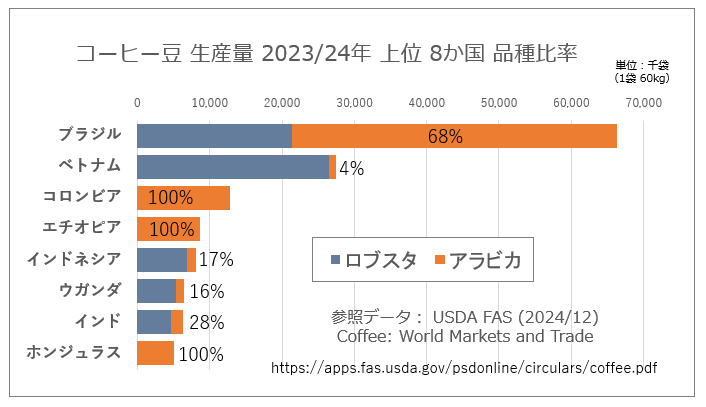
世界のコーヒー豆 生産主要国のアラビカ種/ロブスタ比率と種別ランキング 2024(USDA:米国農務省データ)
世界で流通しているコーヒー豆の品種は大別して「アラビカ種」と「カネフォラ種(ほぼロブスタ)」の2つ。生産国ごとに割合は違うので、生産主要国について比率と種別ランキングを昨年に続けて 2024年版 を調べました。 目次 「 ...
coffeezuki.comThe Fundamentals: What Actually Separates Arabica and Robusta
Clearing Up the Names: Robusta = Canephora's Headliner
Starting with the basics: Arabica is Coffea arabica, a proper species name. Robusta is a slightly different story. The trade and everyday conversation call it "Robusta," but it is technically a common name for the best-known type within Coffea canephora. Sources like UCC COFFEE MAGAZINE and BASE COFFEE flag this as a common stumbling block for beginners.
This distinction matters when reading flavor comparisons. "Arabica vs Robusta" really means Arabica vs the commercially dominant Canephora type traded as Robusta. Calling it "Robusta" works perfectly in conversation, but knowing the taxonomy is a loose shorthand helps you parse information more accurately.
In broad strokes: Arabica excels at floral, fruity, bright-acid expressions, while Robusta delivers 苦味, thick コク, and grain-and-nut intensity. Grinding Arabica releases an immediate, layered wave of aromatics; Robusta tends to lead with toasty density rather than height. The naming detail is dry, but it is the foundation for everything about flavor, price, and use that follows.

アラビカ?ロブスタ??いまさら聞けない「品種」のおはなし | コーヒーと、暮らそう。 UCC COFFEE MAGAZINE
おいしいコーヒーを飲むために、専門用語の知識が必須だとは思いません。 でも、聞くたびに「わからないなーー」でスルーしていた単語も、なるほど!と思えたら、もう一歩先の面白さが見えてくるかもしれません。 今日はそんな専門用語の中から「品種」につ
mystyle.ucc.co.jpGlobal Production Ratios and Key Growing Regions
The global split runs roughly 60% Arabica, 30-40% Robusta. Exact figures shift year to year and vary by reporting body, but the big picture is clear: Arabica is the majority player, and Robusta is a massive presence in its own right. Translation: the aroma-driven bean leads the market, while the コク-and-yield powerhouse supports a substantial share of world supply.
Country-level data sharpens the picture. Vietnam is predominantly a Robusta producer; Colombia is predominantly Arabica. 産地 names alone can give you a rough preview of what to expect in the cup.
Deep-roasting Vietnamese Robusta makes the oil layer on the extracted coffee visibly thicker and the toasty character more defined. It is easy to see why this bean thrives in espresso and Vietnamese-style strong brewing. Colombian Arabica, by contrast, balances 甘味 and 酸味 well even at moderate roast levels, making it a natural fit for black coffee where you want three-dimensional flavor. Altitude and 精製方法 add more variables, but the variety composition at the national level is the root of each 産地's "personality."
Understanding which countries specialize in which variety raises your resolution the next time you scan a bag label and see an 産地 name.
Altitude, Disease Resistance, and Yield
Growing conditions are another axis that separates the two. Arabica favors high altitudes and cooler climates, but it is relatively vulnerable to pests and disease. Careful management is non-negotiable; climate volatility hits it hard. These factors stack up into a cost structure that trends higher.
Robusta thrives at lower altitudes, resists disease well, and yields more per hectare. It is a resilient plant that delivers volume reliably, which is why it fits the stable-supply demands of instant coffee, canned coffee, and espresso blends. Rather than "the cheap bean," Robusta is better understood as a tough, high-yield bean with a defined flavor role.
That toughness shows up in the cup, too. Robusta's caffeine content by bean weight sits at ~2.0-2.7% versus Arabica's ~1.2-1.5%. For a 10g dose, extracted caffeine ranges from roughly 96-120mg (Arabica) to 160-216mg (Robusta). The variety difference extends beyond flavor into how your morning actually feels.
ℹ️ Note
Arabica develops aroma at altitude; Robusta fruits prolifically even in lowlands. The flavor gap in your cup traces directly back to where and how each plant thrives.
Knowing these cultivation traits makes the price and usage differences that follow far more intuitive. Arabica is delicate; Robusta is rugged. That personality gap shows up in the field and in the cup alike.
Flavor Compared Across Five Elements: Acidity, Bitterness, Sweetness, Body, and Aroma
Words alone can only do so much. Breaking flavor into 酸味, 苦味, 甘味, コク, and aroma makes the differences between Arabica and Robusta click immediately. The broad strokes are well known — Arabica is fruity and floral, Robusta is bitter and thick — but in a real cup these elements layer on top of each other to form a complete impression. Decomposing them explains why Arabica suits black coffee and why Robusta holds its own in a latte or espresso.
Five-Element Comparison Table
Aligning extraction conditions and comparing side by side is the fastest way in.
| Element | Arabica | Robusta |
|---|---|---|
| 酸味 | Bright and defined. Citrus- and berry-like, with clear edges | Low to mild. Supports the cup from below rather than leading it |
| 苦味 | Soft. Rarely angular unless pushed deep into dark roast | Strong and persistent. Thick lines that linger into the finish |
| 甘味 | Accessible. Honey and fruit 甘味 remain visible even as the cup cools | Reluctant. Roast character and 苦味 tend to dominate |
| コク | Smooth and elegant. Light on the tongue yet capable of a long finish | Dense and heavy. Full-コク weight, tangible liquid thickness |
| Aroma | Fruit and flower complexity. Expands upward — fruity, floral, layered | Direct and earthy. Grain, soil, nuts, chocolate — low-register impact |
Even from this table alone, Arabica emerges as the bean for aroma, 酸味, and 甘味 and Robusta as the bean that builds 苦味 and full-コク drinking satisfaction. In my own experience, Arabica reveals more on the second and third sip as aroma layers open up, while Robusta announces itself with core thickness from the very first sip.
Caffeine content contributes to the 苦味 difference. The commonly cited ranges — Robusta at ~2.0-2.7% and Arabica at ~1.2-1.5% (per MasterClass and others) — mean Robusta carries more caffeine per gram. Caffeine is not the sole driver of perceived 苦味, but it offers a plausible piece of the puzzle.
💡 Tip
Brew both with the same ハンドドリップ method and pay attention as the cups cool. Arabica tends to reveal a gentle wave of 甘味 at lower temperatures, while Robusta's bitter spine steps further forward. Tasting warm and cooled sharpens the contrast.
Typical Flavor Notes
Translating into フレーバーノート makes the gap concrete. Arabica's common descriptors are berry, citrus, and jasmine. At light-to-medium roast, a single cup can hold blueberry tartness, orange or lemon brightness, and a white-floral lift all at once. This fruity, floral character is the heart of Arabica's appeal.
Robusta maps better to dark chocolate, roasted nuts, and grain. Toasty roast character meets earthy, grainy undertones, layered with nutty and bitter-cocoa nuances. Where Arabica's aroma opens upward, Robusta resonates in a lower register — dense and grounded. That chocolate-nut-heavy-コク combination is exactly why Robusta refuses to disappear behind milk.
How Roast Level and Processing Shift the Picture
These five elements are not fixed by variety alone. 焙煎度 and 精製方法 reshape them dramatically. Light-to-medium roasts let Arabica's bright 酸味 and floral aromatics through cleanly, and the variety gap sits right on the surface. Push into dark roast territory and roast-driven 苦味 and toasty character dominate in both, narrowing the perceived distance. Dark-roasted Arabica develops chocolate and 苦味; dark-roasted Robusta concentrates its inherent heaviness further.
精製方法 matters just as much. Natural-process Arabica foregrounds fruit-derived 甘味 — berry intensity and ripe-fruit richness ramp up. Washed-process Arabica cleans up the 酸味 profile, letting florals and transparency shine. The same Arabica can swing from "clean citrus" to "sweet ripe fruit" on 精製方法 alone.
Robusta responds to roast choices too. Medium-dark brings nut and cocoa into coherent focus; push deeper and earthiness and bitter punch intensify. Espresso blends use Robusta for exactly this — reliable コク and 苦味 stability. Conversely, chasing delicate aroma shifts through a ハンドドリップ is a game Arabica wins more often.
Factoring in roast design, variety is not a fixed verdict. Arabica is a platform that stretches aroma and 甘味 well; Robusta is a platform that builds 苦味 and thickness well. Roast-level impact on flavor is massive — as any roast-level selection guide will confirm — and variety difference layers on top of that. Think of them as two dimensions that combine to shape the cup.
Why the Price Gap Exists: Two Drivers — Cultivation Cost and Market Dynamics
Cultivation Conditions and Cost Structure
The Arabica-Robusta price split starts at the farm itself. Arabica demands high-altitude growing conditions, where temperature, rainfall, and sunlight require careful balancing. Hillside farms resist mechanization, keeping harvest and maintenance labor-intensive. The plant's limited pest and disease resistance means more hands-on intervention, and production costs accumulate structurally.
That slow, high-altitude growth is also what builds Arabica's complex aroma and bright 酸味. The appeal and the difficulty are two sides of the same coin. The cleanest, most defect-free Arabica lots command higher prices at the green-bean stage — a premium rooted in genuine production constraints, not branding alone.
Robusta, by contrast, grows well at lower altitudes and resists disease far better. The plant is hardy, and per-hectare yields run higher, which keeps per-kilogram production costs relatively lower. As UCC COFFEE MAGAZINE and Mokable have noted, Robusta's role in powering instant coffee and commercial demand traces directly to this "easy to grow, high to yield" agricultural advantage.
The price gap, then, is not "tasty therefore expensive" versus "commodity therefore cheap." High-altitude, labor-intensive, disease-prone Arabica and low-altitude, resilient, high-yield Robusta operate on fundamentally different cost structures. The difference in your cup starts in the field.
Demand Segments, Market Position, and Price
Cultivation cost is only half the equation. The other half is which markets value each bean and which end uses absorb the supply. Arabica anchors the single-産地 and specialty segments, where complexity of aroma, 酸味, and 甘味 commands a premium. In the black-coffee-as-experience context, the willingness to pay more for Arabica has a clear sensory basis.
Robusta's demand base is broader: instant coffee, canned coffee (a format with enormous popularity in Japan), commercial blends, espresso reinforcement. Per-unit prices are lower, but the sheer depth of volume demand means Robusta's market tightens aggressively when supply dips. BASE COFFEE and others have noted that Robusta's quality spectrum is wide, stretching from basic commodity lots to high-quality offerings — and the price range follows.
International reference prices as of May 2025: Arabica at 9.01 USD/kg, Robusta at 5.24 USD/kg. Arabica remains structurally higher. However, Bloomberg reported the Arabica-Robusta gap at approximately 1.60 USD/lb in April 2025, and the gap itself fluctuates with market conditions. Arabica does not sit a fixed margin above Robusta; weather, harvest forecasts, and substitution demand cause the spread to widen and narrow cyclically.
The 2025-2026 price surge made this interconnection especially visible. Drought and heat stress in Brazil pressured Arabica supply, while dry conditions in Vietnam squeezed Robusta. When buyers tried substituting Robusta for expensive Arabica, demand for the substitute itself surged, pushing both higher simultaneously. From my own green-bean sourcing, Robusta quotes climbed faster than expected through early 2025. The bean I relied on as a cost stabilizer in blends became a cost headache of its own. That kind of market is humbling.
When the "Robusta = Cheap" Rule Breaks
The key nuance: Robusta trends cheaper on a relative basis, but it is not always cheap in absolute terms. Weather disruptions in major producing regions can send prices spiking. Vietnam, the world's leading Robusta supplier, transmits its harvest anxiety directly into global prices.
By September 2025, average Robusta prices stood at 4.66 USD/kg (per sources including the World Economy Data website). That represents a pullback from May's 5.24 USD/kg, but hardly a return to historically "cheap" territory.
There is also a quality-driven reevaluation underway. Fine Robusta and specialty-grade Robusta lots are gaining recognition. At that tier, pricing reflects use case and cup quality, not just "cheaper than Arabica." In espresso blending, Robusta is increasingly chosen not to cut costs but to engineer crema and コク deliberately.
ℹ️ Note
In volatile years, tracking the gap alone is not enough. Which variety rose more, from a base where both were already elevated — that is the question that matches reality. 2025-2026 is a textbook example: the spread both widened and narrowed depending on which supply shock was dominating at the time.
For all these reasons, the "Robusta = cheap, Arabica = premium" shorthand distorts the current market. The structural tendency is real, but weather, supply-demand dynamics, substitution pressure, and the rising profile of quality Robusta all introduce volatility. Price differences are not a brand hierarchy — they are the result of cultivation difficulty and market forces compounding on each other.
2025-2026 Price Trends: How the Arabica-Robusta Gap Has Moved
Weather Disruptions Across Major Origins and Market Ripple Effects
The reason coffee felt expensive to buy in 2025 comes down to simultaneous weather hits across major producing regions stacking on top of the existing variety-level price structure. On the Arabica side, drought and heat waves in Brazil fueled supply fears. On the Robusta side, drought in Vietnam pushed prices upward. When both escape valves narrow at the same time, the market has nowhere to relieve pressure.
The numbers: international prices in May 2025 stood at 9.01 USD/kg for Arabica and 5.24 USD/kg for Robusta, per Ilmiio Roastery's compilation. Both sat in elevated territory. Brazil's influence on Arabica futures is outsized — prolonged heat and dry air during flowering and fruiting translate directly into buying pressure on futures. Arabica already reacts sharply when supply tightens; 2025 layered weather risk on top of that sensitivity.
Robusta was not spared. Vietnam's production skews overwhelmingly toward Robusta, so drought concerns there ripple immediately into the cost of instant coffee, commercial blends, and espresso base ingredients. The price did not creep up — it jumped. Through early 2025, my roasting-supply quotes for both Arabica and Robusta stepped up noticeably, and holding blend ratios steady without absorbing higher cost became impractical. On the retail side, a visible trend emerged: brands shifted from 250g bags to 200g bags at the same sticker price. A 200g bag of roasted beans weighs about as much as a smartphone, and it barely registers in a shopping bag — yet the per-cup math hits harder than before. That silent shrinkflation captured the mood of the market.
Looking ahead, the 2026 Arabica average price forecast sits around 7.25 USD/kg. Brazil's projected total output is 66.2 million bags (Arabica: 44.1 million, Robusta: 22.1 million), and the weight of Arabica in that mix keeps its influence on global pricing elevated.

2025年 世界のコーヒー価格の現状とその要因
インタラクティブ・コーヒー価格レポート 世界のコーヒー市場の現状と、価格を動かす複雑な要因を、データとインサイトを通じてインタラクティブに探ります。(2025年6月更新) 市場サマリー (2025年5月) 世界のコーヒー価格は、主要生産国の
ilmiioroastery.comReading the Widening and Narrowing of the Price Gap
Tracking Arabica and Robusta means watching not just which is higher, but whether the gap is expanding or contracting. In late April 2025, Bloomberg pegged the spread at approximately 1.60 USD/lb, a moment when Arabica's premium was running especially hot. Brazil's weather anxiety was the primary fuel.
The gap does not move in one direction. When Arabica climbs too high, roasters and beverage manufacturers look to substitute Robusta where they can. That substitution pushes Robusta demand higher, and Arabica's surge triggers a Robusta surge that compresses the spread. 2025 was a year of exactly this back-and-forth. Demand fleeing expensive Arabica flowed into Robusta — which was itself constrained by Vietnamese drought — so the substitute got more expensive too.
September 2025 data captures one frame of that cycle. The World Economy Data website recorded average Robusta at 4.66 USD/kg (~689.18 JPY/kg / ~$4.66 USD). Down from May's 5.24 USD/kg, but not at a level anyone would call "cheap." The spread narrowing here did not mean relief — it meant both were elevated and converging from high bases.
This cycle bleeds quietly into flavor decisions. Shops that depend on Arabica for black-coffee aroma absorb cost through roast adjustments, blend tweaks, or portion redesign. Shops that use Robusta in espresso and lattes face the same pressure from the other direction — the bean that was supposed to add コク affordably is now a cost driver itself. Spring 2025 was a season where "neither choice makes sourcing lighter," and tracking the spread as a simple higher-lower metric felt inadequate.
💡 Tip
The key to reading 2025-2026 coffee prices: do not track Arabica and Robusta in isolation. Follow the chain — Arabica supply fear drives substitution into Robusta, Robusta's own weather issues tighten that market further — and you will understand why the gap widens and narrows in rhythm with whichever shock is dominant at the moment.

コーヒー豆価格の推移 - 世界経済のネタ帳
コーヒー豆価格の推移をグラフ及び時系列表にて掲載しています。
ecodb.netHow Yen Weakness Amplifies the Hit to Household Coffee Budgets
For buyers in Japan, the international price surge alone does not explain the sticker shock. A weak yen multiplies the dollar-denominated commodity increase on its way to the household budget. Both Arabica and Robusta trade internationally in USD. Even a flat commodity price feels more expensive in yen when the currency is soft. Layer the 2025 price spike on top, and the retail-level pain intensifies.
The same structure applies to Robusta. September 2025's average of 4.66 USD/kg translated to 689.18 JPY/kg (~$4.66 USD). What this reveals: "Robusta is relatively cheap, so it is easy on the wallet" no longer holds in yen terms. A USD-denominated decline does not lighten the burden if the yen weakens in parallel. Conversely, when both Arabica premiums and yen weakness run in the same direction, single-産地 and Arabica-focused blends absorb the most visible price hikes.
At the household level, the math becomes tangible. A bag shrinking from 250g to 200g barely changes shelf appearance, yet per-cup cost creeps upward. A 200g bag of roasted beans weighs roughly as much as a smartphone — easy to overlook in a shopping bag. The receipt, though, carries more weight than it used to. That gap between physical impression and financial impression is commodity prices and exchange rates compounding through retail.
So the 2025-2026 household burden is not an "Arabica or Robusta" question alone. Whether commodity direction and exchange-rate direction align determines how sharp the increase feels. Arabica's higher base price makes yen weakness more visible per gram; Robusta's eroding discount shows up as rising costs for blends and everyday coffee. That nagging sense of "everything is more expensive" at the shelf — that is an accurate read.
Which Should You Pick? A Purpose-Driven Guide
Recommendations by Use Case
The simplest framework: what are you adding to it and how are you extracting it. Whether you want the bean's character front and center or need it to survive milk and sugar determines which variety fits.
For black coffee where aroma leads, the axis is Arabica 100%. Light-to-medium roast pairs naturally with ハンドドリップ: citrus brightness, floral lift, berry-toned 甘味 come through cleanly. On an unhurried morning, pouring water and watching aromatics bloom with each stage of the drawdown — that is where Arabica delivers its highest satisfaction. Evenings, I often drip a light-roast Arabica at around 90 C and let the aroma layers unfold slowly.
When milk or sugar enters the picture, Robusta-forward or a blend with 30-50% Robusta becomes more practical. Robusta's strong 苦味 and thick コク hold their shape against dairy 甘味 and sugar's rounding effect. An all-Arabica latte produces lovely aromatics but can trend gentle when the milk volume goes up; a Robusta blend keeps the coffee assertive. If you want a cup that reads as bold and never watery, Robusta delivers.
Espresso sharpens the contrast. Blending Robusta to reinforce crema and structure is a standard approach. An Arabica 60 : Robusta 40 design builds concentration and forward punch visibly — shot or latte, the presence is unmistakable. Morning espresso with a 30% Robusta blend flips the focus switch faster, and the flavor is as direct as the caffeine.
Iced coffee suppresses aroma diffusion, so deep-roasted Arabica or a blend with a small Robusta addition works well. You need enough outline to survive dilution by ice. For brightness with depth, lean toward dark-roast Arabica. For sharper 苦味 and forward push, a modest Robusta percentage does the work.
If caffeine is the priority, raising the Robusta share follows logically. Variety difference is not just flavor — it is how hard your morning hits. A pre-work cup with serious spine makes practical sense, but the stronger you go, the more dose calibration matters. Think of Robusta not just as "the bitter bean" but as a bean worth choosing specifically for caffeine load.
The caffeine angle bears repeating. Reaching for more Robusta when you need alertness is a rational move — the variety difference shows up in how your morning functions, not just how your cup tastes. Just keep an eye on dose and extraction design as intensity goes up. Framing Robusta as a deliberate caffeine choice, rather than a flavor compromise, makes the decision cleaner.
Reading the Label: Buying Tips
The frustrating part of shopping for coffee: the front of the bag screams "Blend" or "Dark Roast" or "Espresso," but the information that predicts flavor hides in the fine print. A few reliable signals are all you need.
First, check for an "Arabica 100%" label. Its presence raises the odds of an aroma-forward design substantially. Pair it with light-to-medium roast, single 産地, and flavor descriptors like floral or citrus, and the direction is clear. If no Arabica-100% claim appears and terms like "Espresso Blend," "Italian Blend," or "Latte Roast" lead the label, factor in the likelihood of Robusta content — it helps you forecast the cup more accurately.
Second, 焙煎度 indication. Light-to-medium tilts toward aroma and 酸味; medium-dark-to-dark shifts toward 苦味 and コク. Even an Arabica-centered dark roast suits iced coffee; a Robusta blend at the same level doubles down on backbone for lattes. When the variety is not stated, reading 焙煎度 alongside the intended use narrows things down.
Flavor descriptors on the bag are useful signals, too. Citrus, floral, berry language points toward Arabica-driven complexity. Nut, chocolate, bitter, bold language suggests Robusta content or deeper roast design. Roast and extraction will always modify the final cup, but packaging copy tends to be surprisingly honest.
When a bag says "Blend," ignore vague image text and look for use-case language. "For black coffee," "for cafe au lait," "for espresso," "for iced coffee" — these statements alone make selection efficient because they encode the brewer's intent: crema and concentration for espresso; ice-proof outline for iced; 苦味 and コク retention for milk drinks.
Pack size matters more than it might seem. A 200g bag of roasted beans weighs roughly as much as a smartphone — manageable for everyday use and not too much for a comparative tasting. Buying an Arabica and a Robusta-containing blend in the same size lets you compare direction before either bag runs out, with no storage headaches. Too large a bag and comparison fatigue sets in before you have drawn conclusions.
How to Taste the Difference: A Same-Conditions Side-by-Side
Align your conditions and the Arabica-Robusta gap jumps out with startling clarity. Change the dose, water temperature, and brewer simultaneously and you end up tasting recipe differences, not variety differences. Keep it simple: same brewer, same dose, same water volume.
The steps:
- Get one Arabica 100% and one Robusta-containing blend. This pairing makes the directional contrast easy to see.
- Grind the same weight of each and brew with the same device. ハンドドリップ or French press both work — just pick one and stick with it.
- Match water temperature. 90 C is a good neutral point where Arabica's florals and Robusta's push both come through.
- Taste black first. Compare aroma, 酸味, 苦味, and the weight of the aftertaste.
- Add an equal amount of milk or sugar to each and observe what survives. This is where Robusta's grip becomes obvious.
- Let them cool a bit and taste again. How each cup holds up at lower temperatures informs iced-coffee suitability.
In practice, Arabica tends to separate itself on first-sip aroma spread, and Robusta asserts itself through the 苦味 and thickness that linger after swallowing. Add milk and Arabica's clean aromatics dissolve gracefully while the Robusta blend keeps its edges. Just this observation turns "for black" and "for lattes" from abstract labels into felt experience.
Espresso drinkers can apply the same logic to pulled shots. Robusta-blend shots show crema thickness and mouthfeel differences obviously; Arabica-centered shots win on aromatic finish. For iced coffee, extract equal volumes over ice and track which one maintains a visible line after dilution — deep-roast Arabica versus a light Robusta addition, side by side.
Run this comparison a few times and your personal answer to "do I chase aroma or thickness?" becomes unmistakable. Variety knowledge turns into a flavor map, and bag labels start reading differently.
What Robusta Does in a Blend
Adding Robusta to a blend engineers a kind of forward push that Arabica alone struggles to produce. The most visible change is liquid thickness and crema. In espresso especially, Robusta boosts コク density and crema volume noticeably. The taste impression is less about raw 苦味 amplification and more about a structural spine forming in the cup. Milk-based drinks keep their edges because that spine holds.
For reference, international prices sit around 9 USD/kg for Arabica and 5 USD/kg for Robusta, so even a small Robusta addition can improve both コク and cost efficiency. (Actual landed cost varies with exchange rates, freight, and duties.)
Ratio Guidelines
No need to overthink the math. The approach: let Arabica carry the aroma while Robusta supports from underneath. A standard espresso starting point is Arabica 60% : Robusta 40%. At that level, crema, コク, and the bitter framework are pronounced enough for the shot to work solo or under milk.
For everyday brewing, starting at 10-30% Robusta lets you calibrate without overshooting. At 10%, aftertaste gains a touch of thickness. At 20%, the cup resists milk dilution more convincingly. At 30%, コク and 苦味 assert themselves clearly. Around 20%, I find that lattes finish with a brown-sugar-like bittersweet note; even a small amount of syrup produces a satisfying cup.
Mapping ratios to goals: crema emphasis calls for a higher Robusta share; コク emphasis pairs well with a medium-dark Arabica base plus a modest addition; cost optimization keeps a quality Arabica core and uses a small Robusta portion; ice resistance calls for enough Robusta to maintain outline through dilution. The exercise is not about finding a single correct ratio — it is about deciding what to amplify first and adjusting from there.
The Felt Difference in Espresso and Milk Drinks
Espresso is where Robusta's contribution shows most visually. Crema rises higher and more visibly, and the liquid feels a step thicker on the palate. Arabica-centered shots impress through aromatic finish; Robusta-blended shots impress through texture that stays on the tongue. Even a short extraction reads as "not thin" when Robusta is present, and that is the コク difference at work.
Pair with milk and the distinction becomes functionally important. In a latte or cappuccino, Arabica 100% lets its aromatics melt cleanly into milk's 甘味 — elegant, but the concentration can feel politely restrained as milk volume rises. Bring Robusta into the mix and the bitter-コク spine persists, keeping coffee flavor audible above the dairy. Blends that taste like "strong coffee even in a latte" are usually executing this design well.
Iced preparations benefit too. Chilling suppresses aroma diffusion, but コク and bitter character survive the cold relatively well. A Robusta-blended iced latte holds its outline through the last sip more reliably than an all-Arabica version, in my experience.
ℹ️ Note
Black-coffee-and-aroma days call for Arabica-centered beans. Latte-and-iced days where satisfaction matters more than subtlety call for a blend with some Robusta. Separating your beans by occasion makes selection straightforward.
Small-Batch A/B Testing at Home
Blend differences reveal themselves quickly when you taste small lots side by side. I keep things simple: 200g bags as the base unit. A 200g bag weighs about as much as a smartphone, stores easily, and gets used up before impressions go stale.
The setup: buy an Arabica 100% and a Robusta-containing blend — or, better yet, line up "Arabica 100%," "Arabica 90 : Robusta 10," and "Arabica 80 : Robusta 20." Increasing the Robusta share step by step makes each increment's effect trackable. Align extraction conditions per the previous section, then taste black first and with milk second. The thing to watch is not aroma intensity but how the aftertaste shifts.
If you have an espresso machine, pull equal-dose shots and compare crema thickness, liquid weight, and how much coffee flavor survives after steaming milk in. A 60:40 blend at higher Robusta proportion makes the shot's push and the latte's structural retention immediately visible — a useful exercise for understanding what blending actually achieves. Drip brewers can get most of the same information by adding a small, equal pour of milk to matched brews and tracking コク behavior.
The rewarding part of A/B testing: it proves quickly that "Robusta is always better" and "only Arabica is quality" are both wrong. The right answer changes with the use case. A short, punchy morning shot, a midday milk drink, an evening cup where aroma unwinds slowly — each asks for a different design. Blending is not compromise. It is building a cup to fit how you are drinking it, and once you see that, the options open wide.
Wrapping Up: Understanding Flavor and Price Makes Bean Selection Genuinely Fun
Choosing between Arabica and Robusta is not about ranking one above the other. It is about knowing what you want your cup to feel like and matching accordingly. Once the five flavor elements, caffeine, and price dynamics connect in your head, the assignments fall into place naturally: Arabica 100% for black, Robusta blends for lattes and iced, and balanced blends for everyday versatility. Even brewing the same 抽出レシピ with different beans reveals the variety's character before technique ever enters the picture. Building a habit of reading bag labels is enough to make coffee shopping more interesting.
Your Next-Step Checklist
- Check the bag you have at home right now — is it "Arabica 100%" or a blend?
- Next purchase, buy one Arabica 100% and one Robusta-containing blend and taste them under identical conditions.
- Start splitting your beans by purpose — one for black, one for milk drinks — and feel the difference firsthand.
Once variety clicks, expanding into 産地, 焙煎度, and storage deepens your decision-making speed further. For connected reading, an 産地 comparison guide and a 焙煎度 selection guide tie the threads together into a single framework for choosing beans with confidence.
Related Articles
Coffee and Food Pairings: How to Match Your Brew with Breakfast, Snacks, and Desserts
When you're not sure whether your coffee is actually working with what you're eating — whether it's breakfast, an afternoon snack, or dessert — two principles cut through the guesswork: layer similar aromas for harmony, or use contrast to cleanse the finish.
Tasting, Cupping, and Omakase Coffee Courses: What's the Difference and How to Choose
Coffee experience events often list tasting sessions, cupping classes, and guided 'omakase-style' courses — and while they may sound similar, each one serves a distinct purpose. Tasting is about observing flavor, cupping is a standardized method for comparing quality, and omakase-style courses are designed so discovery happens without the guesswork.
Light Roast vs. Dark Roast: 5 Flavor Elements and Water Temperature
Light roasts bring out fruit-forward acidity and delicate florals, while dark roasts push bitterness, toasty warmth, and a heavier body to the front. Change nothing but the roast level, and the same bean will taste like an entirely different coffee.
How Grind Size Changes Your Coffee: A V60, French Press, and Espresso Reference
When your coffee tastes inconsistent, the first thing to revisit is not the beans but your grind size. A shift in particle size changes both extraction speed and surface area, which determines whether acidity leads, sweetness lands, or bitterness and astringency dominate the cup.